 drawguard.io
How to measure combined drawdown when several EAs share one MT5 account
Short answer: the combined drawdown of several EAs is the fall in the account's equity from its own peak. It isn't the sum, the average or the worst of the individual backtest drawdowns. Measure it from live equity, which includes every open position, and then split each dip by magic number to see which EA drove it.
This guide explains why the per-EA numbers don't add up, how to compute the combined figure yourself, and where a live record of each EA's open positions fits in.
Why per-EA drawdowns don't add up
You probably picked each EA from a backtest. The MT5 Strategy Tester report gives balance and equity drawdown, absolute, maximal and relative. But the report is generated for one EA in one test, on its own deposit. Three reports tell you nothing about what happens when the three EAs share one balance.
Three things get in the way:
- A 10% relative drawdown in a test on a $10,000 deposit is not 10% of your $100,000 account. It depends on the lot sizes you actually run.
- Peaks and troughs happen on different days in different tests. On a live account they happen on the same clock.
- EAs on related pairs, or grid systems that all suffer in the same volatile session, tend to lose together.
One bound always holds: the account's maximum drawdown in currency can't exceed the sum of the EAs' own maximum drawdowns in currency, because a total can't fall further than its parts do in the worst case. That makes the sum a ceiling, though a loose one. The real number is usually lower, and only live measurement tells you by how much.
What combined drawdown is
Combined drawdown is plain account drawdown. MT5 exposes ACCOUNT_EQUITY, the account equity in the deposit currency, and equity already includes floating profit and loss on every open position, whichever EA opened it. So:
combined drawdown = (peak equity - current equity) / peak equity
Track the running peak, and the maximum of that ratio over time is your maximum drawdown. Here is one day on a 100k demo account in DrawGuard, running three EAs on gold, split by magic number:
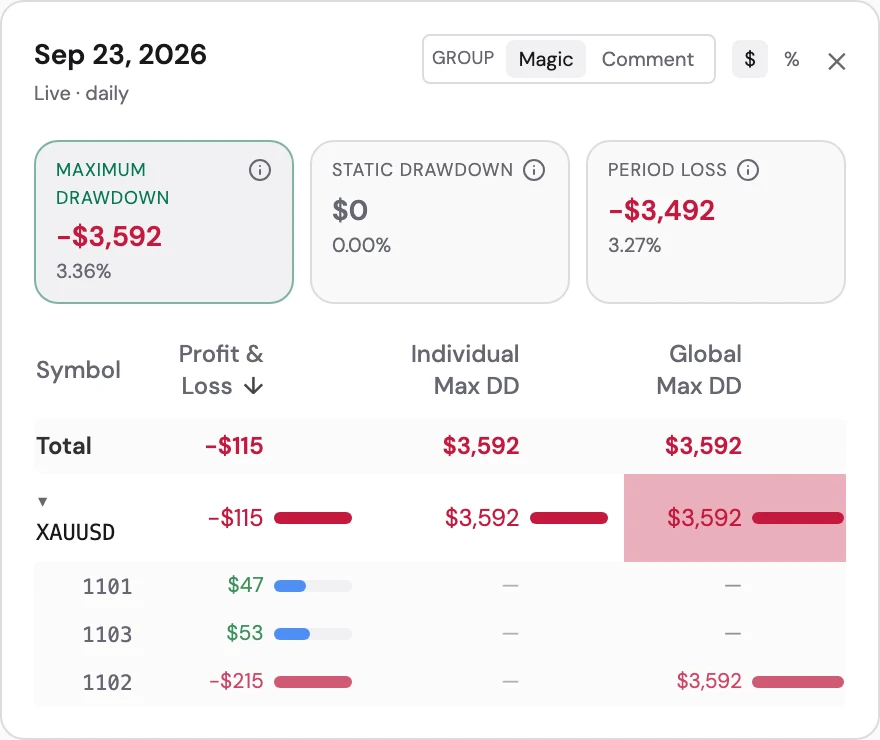
The account's drawdown that day was $3,592, or 3.36% from its peak. That is one figure for all three EAs together. The split shows magic 1102 behind all of it, while the other two finished the day in profit. The day's closing profit and loss was only -$115, so the close hides how far equity fell during the day.
Balance is the wrong thing to watch
ACCOUNT_BALANCE moves only when trades close. A basket that is $3,000 underwater leaves the balance untouched until it closes. Combined drawdown computed from closed trades or balance gives a smooth curve that misses the part that breaches limits. Most prop firm loss limits are measured on equity for that reason, so use equity.
How to measure it yourself
If you only want the account figure, you can build it:
- Log
AccountInfoDouble(ACCOUNT_EQUITY)from an EA or script on a timer, for example once a minute, to a file or a database. - Pick the period, and know which of two numbers you want. A daily drawdown is measured from the day's peak: the highest equity since that day began. A daily loss is measured from the day's starting balance or equity. They differ whenever equity rises before it falls. Most prop firm daily loss limits use the second, so a drawdown from the day's peak is not the figure your firm checks. A single peak that never resets gives the all-time drawdown instead.
- For each period, keep a running maximum of equity and start it again from the first logged equity of the next period. Also store the equity at the start of each day.
- At each log point, compute
(max - equity) / maxagainst the current period's peak, and keep the largest value per day, week and month. For the daily loss, compute(day start - equity) / day start. Keep a separate never-reset peak if you also want the all-time figure.
That gives you the combined number. It does not tell you which EA caused it. For that you also need to log every open position's magic number and floating profit at each tick, then sum floating profit per magic for the moment of the dip. The details are in the guide on drawdown per EA by magic number.
A home-built logger has the usual weakness: it lives inside the terminal. If you restart the platform, the running peak is gone unless you saved it, and if the VPS is down nothing is recorded.
Reading the combined number
Once you have the number, base your decisions on it instead of on the individual backtests:
- Set the combined figure against your prop firm's daily and maximum loss rules, or your own risk limit. Your firm measures the whole account, and its daily limit usually counts from the day's starting balance, so check its rules for the exact base.
- On the worst day, which magic number held the largest floating loss? That is the EA to resize first.
- If two EAs hit their worst moments on the same days, they are acting as one bet. Cutting lots on one of them lowers the combined figure more than trimming an EA that loses on its own schedule.
How DrawGuard measures it
DrawGuard records instead of reconstructing. You attach its free EA to one chart on the account. It doesn't trade, and it doesn't touch your other EAs. Every 60 seconds it sends the account's equity and every open position, with symbol, magic number, comment and floating profit. From that:
- Drawdown is tracked over global, daily, weekly and monthly periods at once, from peak equity, from the starting balance (static) or from where the period opened.
- Each day, week and month is broken down by symbol, magic number and comment, showing which one caused its drawdown, and that attribution is kept for finished periods.
- Alerts on paid plans email you when drawdown crosses a limit you set, with presets for common prop firm rules.
Its limits: data starts when the EA connects. Closed trade history can be imported, but floating drawdown from before the connection can't be recovered. The terminal also has to keep running, which usually means a VPS. DrawGuard monitors and warns. It never places or closes trades, so if you want positions closed at a limit you still need an equity protector EA or your firm's own rules.
You can look at the real dashboard on three simulated accounts with no sign-up.
FAQ
Is combined drawdown the sum of each EA's drawdown?
No. It is the drop in the account's equity from its own peak. In currency it can't be larger than the sum of the EAs' individual maximum drawdowns, but it is usually smaller, because the EAs rarely hit their worst points together.
Should I measure combined drawdown on balance or equity?
Equity. Balance moves only when trades close, so it hides floating losses. Prop firm loss limits are usually measured on equity.
Can MT5 show the combined drawdown of several EAs on a live account?
MT5's Trading Report covers the whole account and doesn't separate EAs. To see which EA caused a dip you need a record of equity and open positions by magic number, taken while the dip happens.
Why is my account drawdown bigger than any single EA's backtest?
Backtests use their own deposit and lot size, and they run alone. Live, the EAs share one balance, and their losses can overlap in time.